
If you’re asking what MERV rating for your furnace is best, many factors should inform your decision. An air filter can noticeably impact your house’s air quality, energy use, and even your systems lifespan. Choosing the right filter size matters, but the MERV rating is what will make the final impact on filtration quality. For a more precise description, the MERV rating will indicate how well a filter captures airborne particles.
A higher MERV rating isn’t always best for every furnace. The best rating you can choose is based on your home’s needs, your HVAC system, and your budget. This article will provide you a guide on what MERV ratings mean, how they affect your HVAC system, and how to choose the correct rating based on your needs.
Contents
What Does a MERV Rating Actually Mean?
MERV stands for Minimum Efficiency Reporting Value. MERV is a rating system that measures how well an air filter can capture particles in the air. The higher a MERV rating is, the better it can capture smaller particles. MERV rating can range anywhere from 1 to 20, although most residential HVAC systems will use filters found in the ranges 5 to 13. A higher-rated filter can capture finer dust, pollen, mold spores, and other contaminants.
A higher MERV rating isn’t always better for your furnace. Before choosing a higher MERV rating, you need to ensure your system is designed to handle it. A filter with too high of a rating can put strain on your system, shorten its lifespan, and perform less efficiently. Choosing the correct filter comes down to finding the right balance between airflow and filtering quality. Check out the EPA’s guide to MERV ratings for a more in depth explanation.
MERV 8 vs. MERV 11 vs. MERV 13
MERV 8
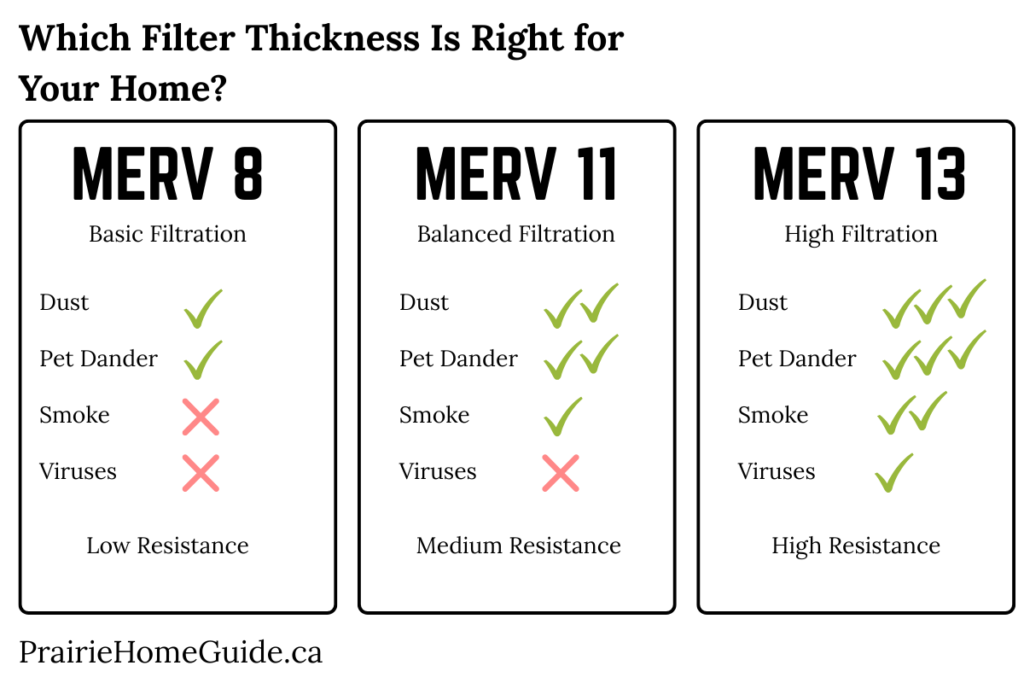
MERV 8 filters are a basic choice for HVAC systems. They do a good job at capturing common airborne particles, pollen, mold spores, and pet fur. MERV 8 is a popular choice for standard residential systems because they provide basic filtration without any issue.
For older furnaces and HVAC systems, MERV 8 is a great choice because its airflow isn’t as restrictive as higher MERV options. Using too high of a MERV rating with an older system can damage it over time.
MERV 11
MERV 11 filters provide higher-quality filtration than MERV 8. They will reduce airborne particles such as fine dust, pollen, pet dander, and other contaminants. MERV 11 is a good option for people who want to improve their homes air quality without immediately jumping to the highest residential options.
MERV 11 will be the best choice for you is you want something better than the most basic filtration available for pets and allergies. Before using a MERV 11 filter, make sure that your HVAC system can handle using it. Using a filter with too little airflow can place strain on your system.
MERV 13
MERV 13 filters are one of the best options for a high-rated filter for a residential HVAC system. A filter rated at MERV 13 will capture a greater amount of smaller particles in the air than MERV 8 or MERV 11. If you are a homeowner who prioritizes indoor air quality, it’s worth considering a MERV 13 filter.
If you have a residential HVAC system and want the best possible filtration for fine particles, smoke, allergens, and other contaminants, MERV 13 is the best choice for you. Before you switch to a MERV 13 filter, check that your HVAC system can handle using a filter with that rating. It’s also worth considering that a higher-rated filter will get dirtier quicker, meaning you will have to replace it more often, or you may put strain on your system if you don’t.
Can a MERV Rating Be Too High for Your Furnace?
Yes, a filter with too high of a MERV rating can harm your HVAC system. If you’re asking what MERV rating you should use, a higher one isn’t always the best choice.
Filters with a higher MERV rating have more surface area to capture fine particles, which also makes it harder for air to pass through. If you have an HVAC system that isn’t created to handle higher resistance, using a filter with a MERV rating that’s too high can reduce airflow. This will cause the system to work harder which can increase energy usage, reduce heating performance, and shorten your HVAC systems lifespan.
The right MERV rating depends on your furnace and what your manufacturer says. If your manufacturer recommends a specific MERV range, it’s best to stay within that. Don’t choose a filter just because it has a high MERV rating, make sure your furnace can handle it while keeping proper airflow.
It’s also important to consider that when a filter becomes clogged with dust, debris, or pet fur, it can reduce airflow over time. Even if you are using the correct MERV rating for your system, a dirty filter can also place strain on your furnace.
How to Choose the Right MERV Rating
Choosing the right MERV rating is depends on how much filtration you want and what your furnace can handle. First, you should find your HVAC manufacturer’s recommendations on what MERV rating you should use. If your manufacturer states a specific range, make sure to stay within that or you risk harming your system. Consider your home’s specific needs and conditions such as pets, allergies, dust, and air quality and choose a MERV rating within your recommended range.
For most homes, MERV 8 is a great starting point for basic filtering. MERV 11 and MERV 13 may also be worth considering if air quality is a priority for you and your system can handle it.
What MERV Rating Is Best for Allergies?
MERV 11 or MERV 13 are best for homeowner’s concerned about allergies. Your specific needs should inform what MERV rating is best for your home. If you have significant allergy concerns, MERV 13 is the best choice for you if your HVAC system can handle it.
What MERV Rating Is Best for Pets?
Homes with pets should use a filter with a higher MERV rating if possible with the HVAC system. A MERV 8, 11, and 13 filter should all work for the majority of pet owners as long as replaced regularly. Make sure to pay attention to how fast your filter becomes dirty, because pets may shorten a filters lifespan.
How Often Should You Replace Different MERV Filters?
The MERV rating of your filter affects how often you need to change it, but factors such as pets, number of people, air quality, and how often the furnace runs all impact your replacement schedule. For most filters, check them every 1 to 3 months and replace them if they become clogged.
No matter the MERV rating, make sure to check your filter often. If it look visibly dirty, it’s best to replace it to keep your HVAC system running well. A dirty filter can restrict airflow and reduce your furnace’s performance.
If you’re not sure how often you need to change your filter based on your conditions, check out our guide on how often you should change your filter.
Frequently Asked Questions
Is MERV 8 good enough for a furnace?
For most houses, MERV 8 will provide good enough filtering. It does a basic job at capturing dust, pollen, mold spores, and other particles in the air with low airflow. MERV 8 isn’t the best choice if you indoor air quality is a priority for you. If your furnace can handle it, MERV 11 or 13 will do a better job at capturing small airborne particles. Make sure to choose a filter with a level of filtration you need without going out of the MERV range your system can handle.
Will MERV 13 damage my furnace blower?
A MERV 13 filter shouldn’t damage your furnace blower if you furnace can handle it. The EPA states that most furnaces and HVAC systems can accommodate a MERV 13 filter, although a filter that reduces airflow can damage an HVAC system. If you’re furnace can handle it, there should be no problem with using a MERV 13 filter, as long as you replace it regularly.
What MERV rating do HVAC experts recommend?
There isn’t a universal MERV rating that is best for everyone. It’s recommended to use the highest MERV rating you can that your HVAC system is designed to use if you’re trying to improve filtration.
MERV 8 works just fine in most homes for basic filtering, but the EPA recommends choosing the highest rated filter your furnace can handle.
Is a HEPA filter better than MERV 13 for a furnace?
For most residential HVAC systems, MERV 13 is a more practical option than HEPA when the system can handle it.
HEPA filters do a better job at capturing air particles than MERV 13 filters, but their airflow resistance makes them impractical for residential systems. Most residential furnaces require modification to use HEPA filters.
